Reference counterfactual
Healthy
No degradation is applied, providing a paired reference for the same workload realization.
RACS — Risk-Aware Coordination System
RACS is an open coordination layer for detecting emerging operational risk and coordinating autonomous systems before local disruptions propagate across the broader system.
Why RACS
How RACS works
RACS sits beside autonomous operations as a coordination layer, converting observable system behavior into risk signals that can inform bounded coordination actions.
Sense
Coordinate
Guard
Act
Observable telemetry to Risk prediction to RiskSignal to NetworkBrain to SafetyGate to Coordination action to Autonomous system
V1 experiment
Reference counterfactual
No degradation is applied, providing a paired reference for the same workload realization.
Hard-failure recovery
Robot remains available until hard failure; stranded work is then recovered and reassigned.
Predictive coordination
Observable task behavior can trigger a predictive drain before hard failure. Existing work may complete while new assignments are redirected.
Study scale
30
paired workload seeds
4
disturbance-time WIP conditions
3
conditions per seed/WIP pair
360
total simulations
248
automated tests
Key results
Lower queue AUC and lower latency are favorable.
H1 — Transport coordination
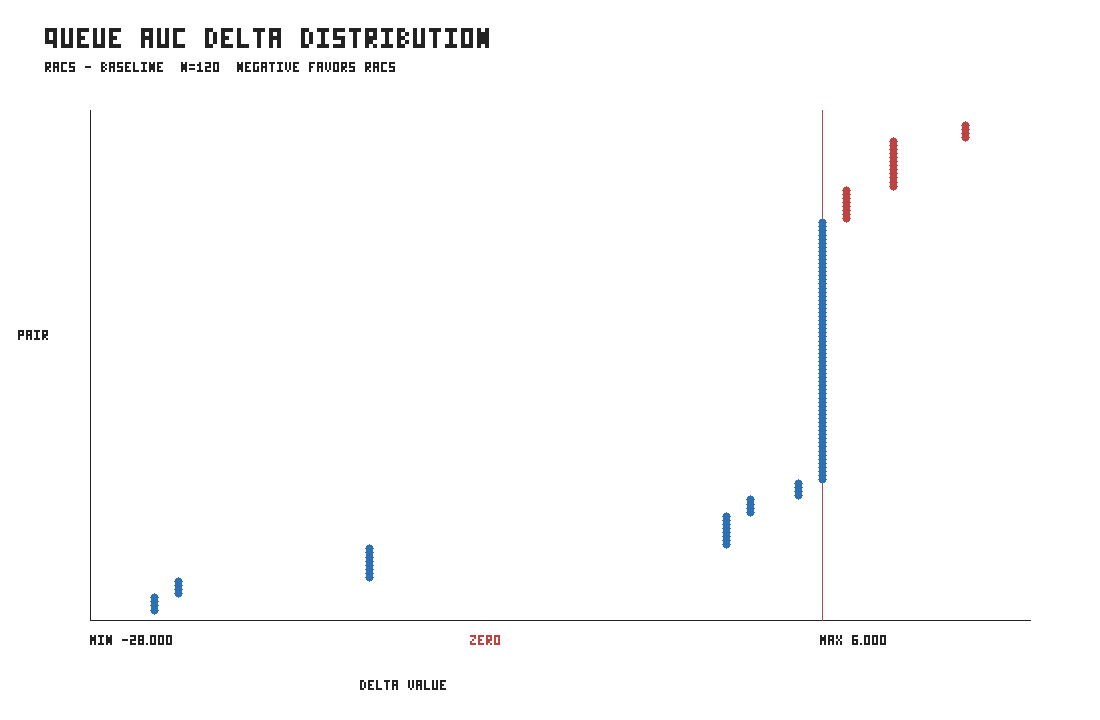
RACS improved mean queue AUC and mean task latency across the seeded study, while individual workload realizations included regressions.
H2 — Earlier intervention and downstream benefit
Downstream benefit was not greater in runs where RACS intervened before propagation than in runs where intervention occurred at or after propagation.
H3 — Intervention headroom
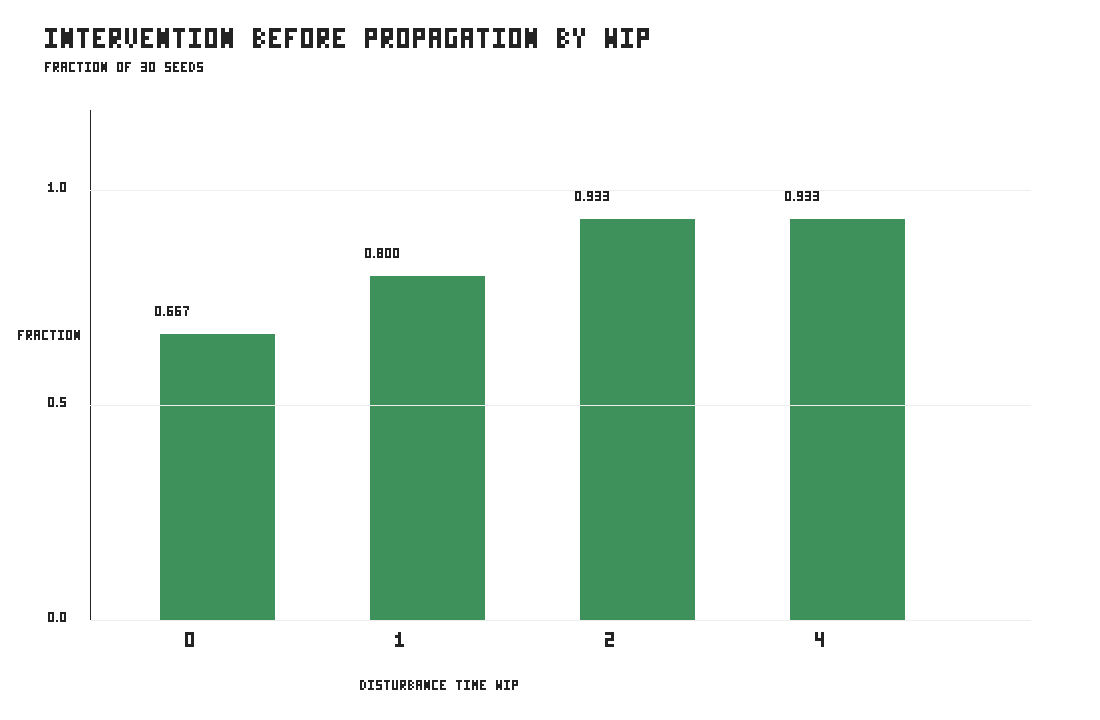
Within the tested WIP levels, greater disturbance-time WIP was associated with a higher fraction of runs in which RACS intervened before propagation.
V1 EVIDENCE
Higher disturbance-time WIP was associated with more frequent intervention before baseline propagation within the tested WIP levels.
Mean queue AUC favored RACS, while 24 of 120 paired comparisons worsened.
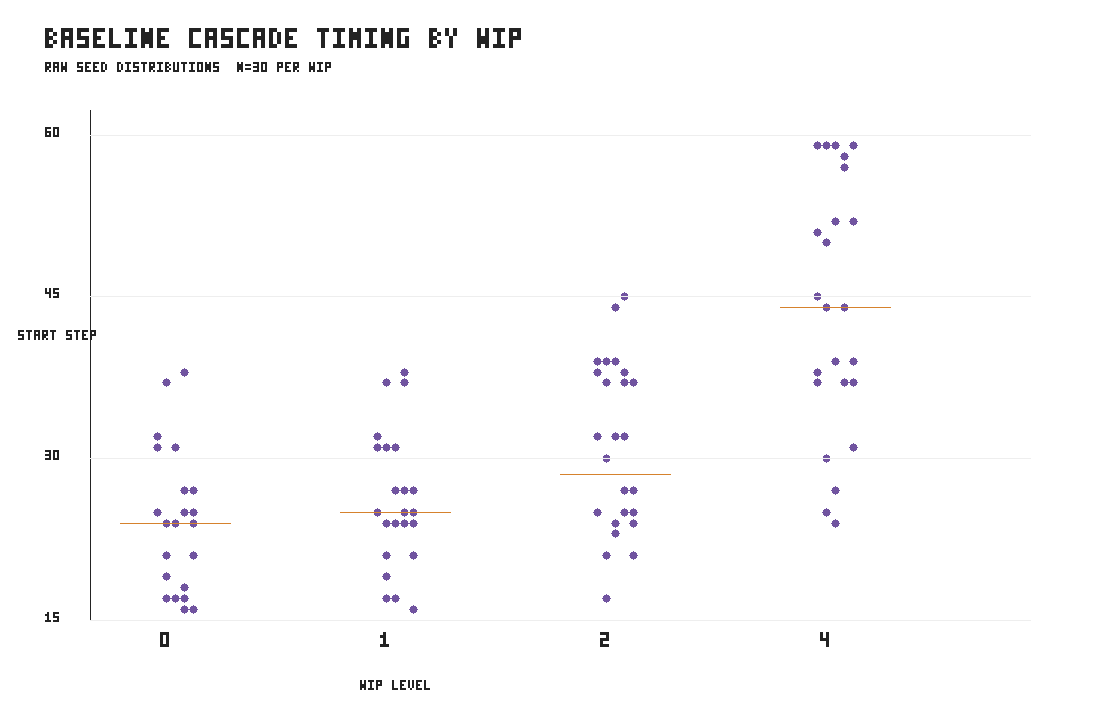
Baseline propagation timing varied by seeded arrivals and shifted later at higher disturbance-time WIP.
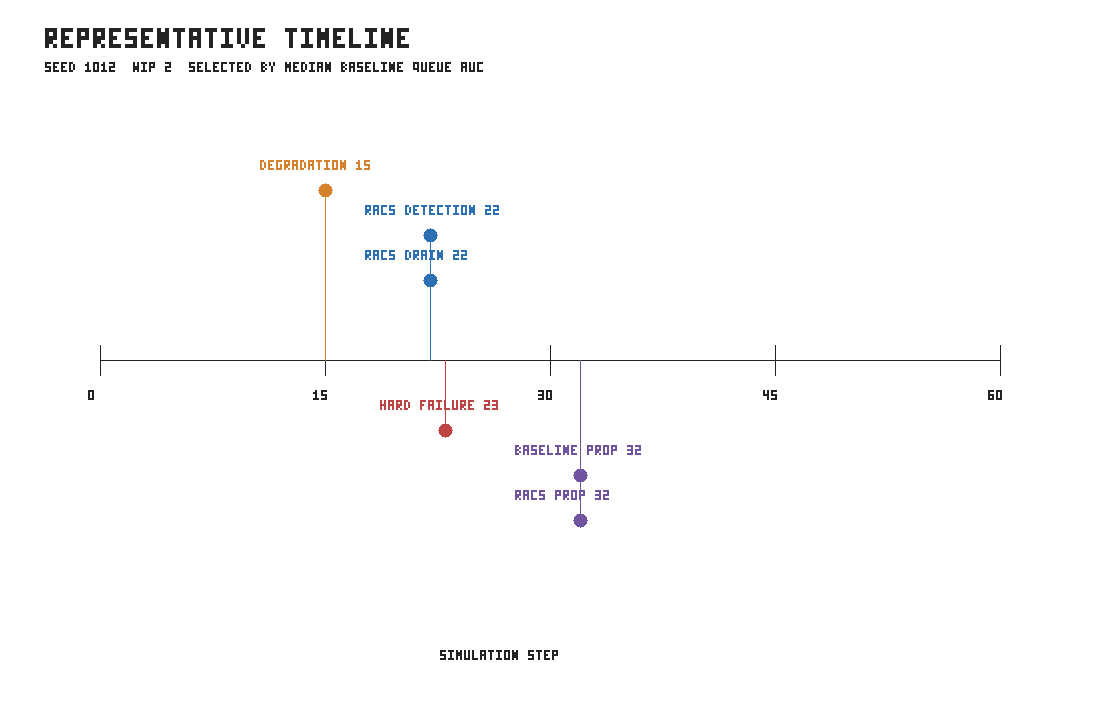
The representative WIP 2 case shows the event sequence available in the frozen result artifact.
Limitations
These limitations define the current scientific scope of the V1 evidence and separate completed work from future validation.
Roadmap
The roadmap distinguishes completed V1 evidence from next-step evaluation and exploratory directions.
V1 — COMPLETE
Reproducible simulation and seeded robustness evaluation
V1.5 — NEXT
External evaluation and independent reproduction
V2 — PLANNED
Robotics middleware / simulator integration
Future — EXPLORATORY
Heterogeneous and broader operational coordination
Evaluate RACS
We are inviting robotics engineers, researchers, and autonomous-systems practitioners to reproduce, critique, and extend the V1 experiment.